
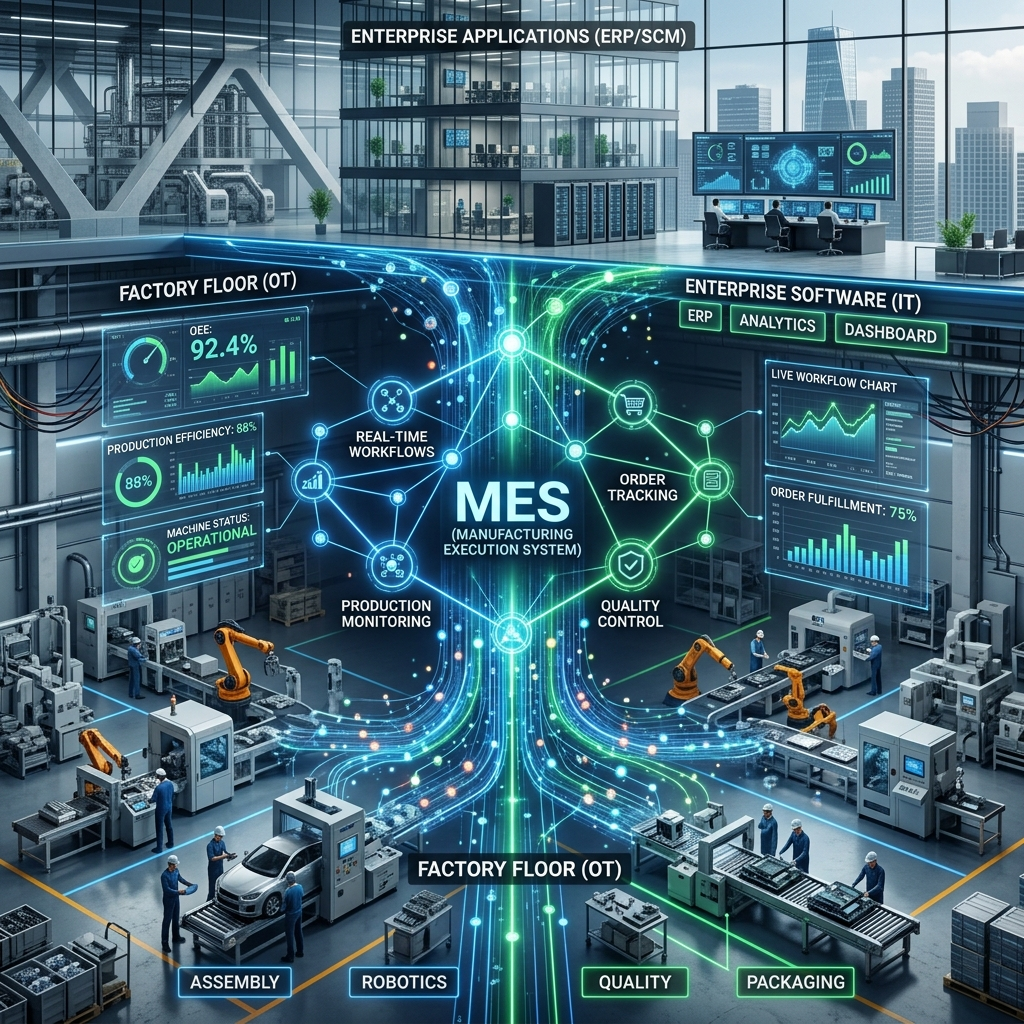
In the highly competitive world of modern manufacturing, the gap between an idea conceived in engineering offices and the final product on the factory floor is bridged through the use of advanced tools.
Software systems serve as a vital link between an organization’s high-level planning layer and the machinery and equipment on the production line.
A Manufacturing Execution System (MES) sits at the very heart of this process, enabling the real-time monitoring and optimization of shop-floor operations.
Without a precise and clear view of what is happening on the shop floor, management decision-making is effectively reduced to guesswork.
In this article, we provide a comprehensive examination of the MES concept, its key components, and its indispensable role in enhancing production productivity.
Technical Description and Analysis
A Manufacturing Execution System (MES) is a software solution that monitors and guides production processes—from the issuance of a work order to the completion of the final product.
This system acts as the “missing link” between Enterprise Resource Planning (ERP) software and industrial automation equipment.
While ERP systems focus on finance, sales, and high-level planning, an MES manages operational details, precise scheduling, and the status of machinery.
A primary function of an MES is the precise tracking and tracing of raw materials and products throughout every stage of the production line.
This traceability capability allows managers to rapidly identify the root cause of any defects within specific production batches.
Other critical functions of an MES include human resource management and the optimal assignment of operators to various workstations, based on their specific skills and certifications. Integrated quality control on the production line, facilitated by an MES (Manufacturing Execution System), shifts the process from traditional, paper-based inspections to real-time digital monitoring.
Automated data logging—achieved through direct connections to machine sensors and PLCs—eliminates human error in production documentation.
Calculating the Overall Equipment Effectiveness (OEE) is one of the most powerful analytical tools within an MES for identifying bottlenecks on the shop floor.
By measuring three key factors—availability, performance, and quality—OEE provides a clear picture of the production line’s actual productivity.
Managing the lifecycle of tools and auxiliary equipment enables maintenance planning based on the actual operational usage of the machinery.
By delivering digital work instructions to operators via displays on the production line, an MES significantly enhances both the speed and accuracy of assembly.
In the event of a stoppage or breakdown at any station, the system automatically alerts maintenance teams and shift supervisors.
Flexibility in custom production—or “mass customization”—is another major advantage of utilizing an MES in modern factories.
This software allows production lines to assemble products with diverse specifications in a mixed, optimized manner, without operational confusion.
Reducing Work-in-Progress (WIP) inventory is made possible by the clear visibility an MES provides into warehouse status and material flow.
Providing transparency regarding actual production costs—including energy consumption, raw materials, and productive labor hours—assists the finance department in establishing accurate pricing.
Compliance with safety and environmental standards is also systematically implemented through continuous monitoring of operational parameters within the MES framework. Integrating information across different work shifts prevents the loss of critical data during shift handovers.
Analyzing historical data recorded within the system assists engineers in optimizing production methods and reducing waste.
Responsiveness to sudden market shifts or urgent customer orders is significantly enhanced through dynamic rescheduling within the MES.
The tight integration of the MES with Industrial Internet of Things (IIoT) technologies enables the collection of vast amounts of high-quality data.
Eliminating paper from shop-floor processes and moving toward “green,” eco-friendly factories are among the additional benefits of this system.
With access to real-time management dashboards, senior executives can monitor progress toward production goals at any given moment.
Consistent final product quality, increased customer satisfaction, and lower product return rates are direct outcomes of an effectively functioning MES.
Operator training becomes faster and less prone to errors, thanks to the system’s built-in, step-by-step visual guides.
Reducing production cycle times leads to increased turnover and improved corporate liquidity.
Synchronizing internal supply chain activities with production schedules minimizes downtime caused by parts shortages.
Conclusion
More than just a simple software tool, a Manufacturing Execution System (MES) serves as the backbone for smart operations and digital transformation in any industrial facility.
By bridging the gap between high-level management decisions and the realities of the shop floor, this system ensures an organization’s productivity, quality, and agility. Investing in the implementation of a standard MES system is a proven strategy for surviving and excelling in the competitive market of today’s modern industries.