
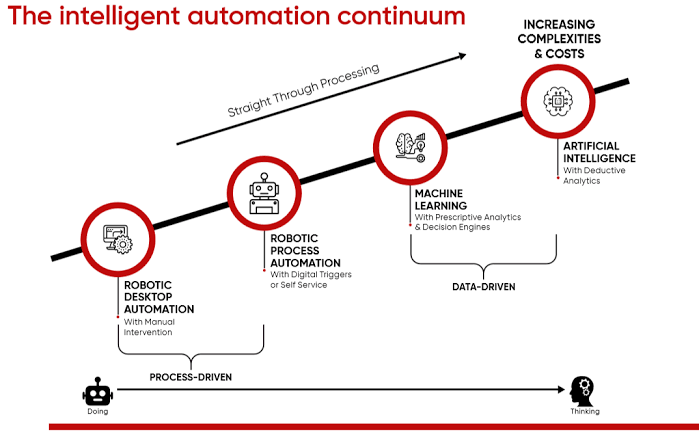
As we transition from the era of traditional automation to the intelligent era, the industry faces one of the most significant transformations in its history—one that is fundamentally altering the nature of production.
Classical automation was built upon the precise repetition of pre-programmed instructions and the elimination of human physical labor.
Intelligent automation, however, introduces a new layer of automated reasoning, analysis, and decision-making into the very heart of production processes.
This shift—from “performing tasks automatically” to “performing tasks intelligently and with self-awareness”—marks the dividing line between competitive success and failure in today’s market.
In this article, we will analyze the transition from isolated systems to data-driven, intelligent systems.
Technical Explanation and Analysis
Traditional automation relied primarily on simple conditional logic—the “IF-THEN” structure—and lacked the capacity to adapt to environmental changes.
In legacy systems, machinery functioned as “information silos,” with no connectivity between the machines themselves or with the management layer.
The transition toward intelligent automation requires a paradigm shift: moving from logic-based control to data-driven control.
At this stage, data is no longer merely an output for reporting; rather, it serves as the primary fuel for the decision-making engines within control systems.
The use of advanced sensors and modern communication protocols enables the extraction of a “digital” representation of the production line’s physical state.
The creation of a “digital twin” is a cornerstone of this transition, allowing processes to be simulated within a virtual environment. Through digital simulation, engineers can test and evaluate changes to the production line with high precision before implementing them physically.
Integrating artificial intelligence (AI) and machine learning (ML) into control layers shifts automation from a reactive mode to a predictive one.
By analyzing complex patterns, intelligent systems can detect minor variations in quality before they result in waste.
Wireless connectivity and 5G networks provide the infrastructure required for the rapid, high-volume transmission of data within demanding industrial environments.
This connectivity enables a transition from localized, station-based automation to distributed, coordinated automation across the entire factory floor.
The convergence of operational technology (OT) and information technology (IT) represents both a major challenge and a significant opportunity in the current era.
Linking shop-floor PLCs with enterprise management software creates a transparent and seamless flow of information.
Intelligent automation directly links supply chain management to the real-time operational capacity of machinery.
In this model, if a machine slows down, the system automatically adjusts the production schedule for other segments of the operation.
Reduced error rates and increased precision are the direct outcomes of making decisions based on real-time statistical analysis.
Intelligent automation transforms the nature of human oversight from “direct control” to the “management of intelligent systems.”
This shift in roles allows engineers to move away from routine tasks and focus instead on solving complex, strategic problems. Optimizing energy consumption and reducing environmental impact are direct outcomes of the intelligent management of resources within production processes.
By precisely managing the flow of materials and energy, intelligent systems minimize production waste.
Production flexibility refers to the ability of production lines to switch between products rapidly, without requiring prolonged downtime.
Data-driven automation enables this capability through swift software reconfiguration and automated calibration.
In this transition, the scope of security has expanded from the physical protection of machinery to the cybersecurity of industrial data.
Safeguarding control algorithms and sensitive production data is an integral component of intelligent automation infrastructure.
Training the workforce to interact with complex, digital systems is a fundamental prerequisite for success during this transition.
Organizational culture must shift from a traditional mindset toward embracing continuous change and learning from data.
Intelligent automation does not replace humans; rather, it empowers them within large-scale industrial environments.
Ultimately, this transition leads to the creation of factories capable of self-correction and continuous learning.
Conclusion
The transition to intelligent automation is not merely a passing phase; it is a strategic necessity for survival in the era of the Fourth Industrial Revolution.
Moving from isolated systems to data-driven platforms elevates precision, speed, and flexibility to unprecedented levels.
Industries that successfully manage their data intelligently will not only optimize their production but also shape the future of the industrial sector.