
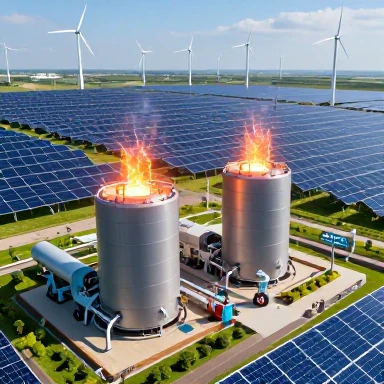
With the growing global focus on reducing carbon emissions and achieving sustainability goals, energy storage has emerged as a cornerstone of the energy transition.
While much of the discussion centers on electrical batteries and electrochemical storage, thermal batteries have surfaced as an emerging solution for energy storage, specifically for industries with significant thermal requirements.
This technology is capable of storing and releasing energy in the form of heat, making it highly suitable for processes such as melting, firing, and refining—all of which demand high temperatures.
Thermal batteries can harness energy from renewable sources, such as solar power, or utilize surplus energy generated elsewhere, storing it until it is needed.
This reduces reliance on fossil fuels and facilitates a decrease in greenhouse gas emissions, particularly within “hard-to-abate” sectors.
Compared to traditional energy storage solutions, thermal batteries offer superior efficiency and performance in applications that require high temperatures and thermal stability.
Implementing this technology requires integrating it with existing industrial systems and selecting appropriate materials for thermal energy storage, thereby optimizing both the storage volume and costs.
Industrial research indicates that by integrating thermal batteries with advanced energy management networks, large-scale facilities can achieve better coordination between electrical and thermal energy.
Ultimately, thermal batteries can play a pivotal role in establishing a flexible, carbon-free energy value chain—especially in industries where reducing fossil fuel consumption remains a significant challenge.