
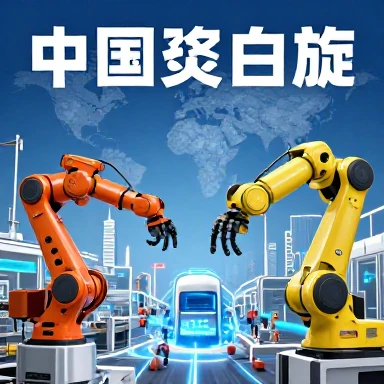
Over the past decade, China has experienced remarkable growth and development in the field of industrial robotics, transitioning from a phase of “catching up” to competing globally in advanced robotic technologies.
This transformation is the result of a combination of technological breakthroughs, substantial government investment, strong domestic demand, and the development of integrated industrial ecosystems.
Chinese robotics companies now maintain a significant presence across various industrial sectors—such as automotive, electronics, packaging, and logistics—and are rapidly enhancing the precision, speed, and artificial intelligence (AI) capabilities of their robots.
A key driver of this growth is the integration of advanced technologies—including machine vision, deep learning, and precise motion control—into industrial robots.
This integration enables robots to perform increasingly complex and sensitive tasks with high accuracy, ranging from the assembly of delicate components to safe collaboration with humans on production lines.
A significant portion of this progress is also attributed to a robust domestic supply chain, the availability of cost-effective components, and an extensive network of suppliers, all of which help reduce both development costs and timeframes.
Consequently, many major global manufacturers now utilize Chinese-made robots on their production lines, a trend that has bolstered confidence in China’s emerging brands.
Furthermore, Chinese firms are expanding into international markets, particularly within developing nations that seek to optimize their manufacturing processes while minimizing costs.
It is anticipated that, with further advancements in AI expertise and sophisticated digital networks, Chinese robots will play a pivotal role in the future of global smart manufacturing.