
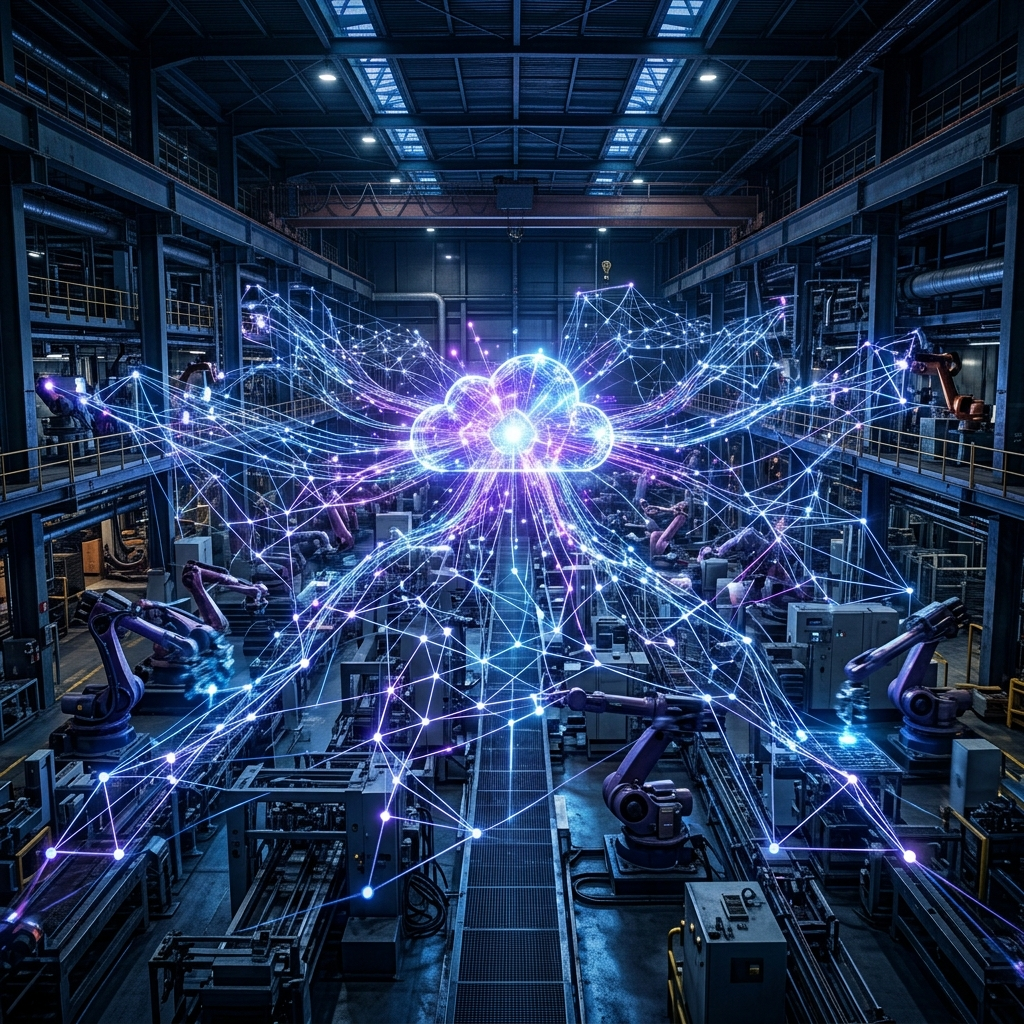
The Industrial Internet of Things (IIoT) represents a quiet yet profound global revolution that has transformed every layer of modern industry.
By intelligently connecting machinery, sensors, and software systems to a networked infrastructure, this technology has blurred the lines between the physical and digital worlds.
Unlike the consumer-facing Internet of Things—which focuses on everyday gadgets—the IIoT is driven by a critical mission: the optimization of complex industrial processes.
For engineers and industrial project managers, a deep understanding of this concept is the key to successfully transitioning from traditional methods to modern, advanced automation.
In this article, we provide a comprehensive examination of the IIoT architecture, its applications, and its pivotal role in shaping the future of industry.
Technical Overview and Analysis
The Industrial Internet of Things (IIoT) refers to an extensive network of interconnected equipment that exchanges data without the need for human intervention.
At its core, the IIoT relies on smart sensors, edge controllers, and robust cloud platforms designed for the analysis of big data.
In contrast to traditional, obsolete fieldbus protocols, modern IP-based protocols enable faster and more open access to field-level data.
A major achievement of the IIoT is the creation of complete transparency across every aspect of the production line and the factory supply chain.
The collection of vast amounts of real-time data (Big Data) empowers organizations to make management decisions based on precise, factual information. Edge computing, in conjunction with the Industrial Internet of Things (IIoT), enables heavy data processing to take place as close as possible to the equipment itself.
This hybrid approach significantly reduces system response latency and ensures operational stability during critical conditions.
Predictive maintenance can be implemented with maximum precision by leveraging the continuous stream of data provided by the IIoT.
Artificial intelligence algorithms connected to the IIoT network can detect anomalies early, preventing unexpected production line stoppages.
In the realm of energy management, the IIoT offers effective optimization solutions through real-time monitoring of electricity and fuel consumption.
Due to the vast number of access points, cybersecurity within an IIoT ecosystem represents a complex and critical challenge for network engineers.
Employing advanced encryption methods and industrial firewalls is essential for protecting these networks.
High scalability allows plant managers to add new sensors to the network without needing to alter the core infrastructure.
By optimizing raw material usage and reducing waste, the IIoT lowers operational expenditures (OPEX), ensuring a rapid return on investment.
Integrating legacy, isolated, and siloed systems into an IIoT framework ensures data consistency and cohesion across the entire organization.
Autonomous robots and internal logistics fleets—by maintaining constant connectivity with the network—are able to execute their tasks with the highest degree of precision. The quality of the final product reaches an unprecedented level of consistency and standardization through the continuous monitoring of production parameters within an IIoT framework.
The complete elimination of paper-based documentation and manual processes accelerates workflows and minimizes human error.
Through real-time, cloud-based dashboards, senior executives can monitor the status of a factory from anywhere in the world.
The flexibility of production lines—enabling them to adapt to shifting customer preferences or facilitate mass customization—is made possible by the agility of the IIoT.
International communication standards ensure that equipment from various manufacturers can operate seamlessly together within an IIoT network.
Reducing the environmental footprint of industrial operations—achieved through the precise monitoring of pollutants and optimized waste management—is a significant benefit of this technology.
The development of smart cities and large-scale urban infrastructure relies heavily on distributed IIoT nodes.
Training the workforce to utilize advanced analytical tools and manage IIoT platforms has become an essential requirement in today’s industrial landscape.
Root Cause Analysis (RCA) of equipment failures becomes significantly simpler and more accurate when supported by precise historical data.
Workplace safety for operators is enhanced by removing them from high-risk areas and delegating monitoring tasks to IIoT sensors.
Close collaboration between IT (Information Technology) and OT (Operational Technology) departments is the key to successfully implementing IIoT projects.
The Industrial Internet of Things (IIoT) serves as the foundational infrastructure for concepts such as the “dark factory” (fully automated, lights-out manufacturing). The growing trend in IIoT development signifies a shift in the traditional industrial paradigm toward intelligence and universal connectivity.
Conclusion
The Industrial Internet of Things (IIoT) is more than just a technological trend; it serves as the fundamental backbone of digital transformation and the era of Industry 4.0.
By bridging the gap between machinery, data, and analysts, this technology elevates productivity, sustainability, and innovation to new heights.
Strategic investment in the deployment of IIoT platforms is essential for ensuring survival, competitiveness, and market leadership within the future of the global industrial landscape.