
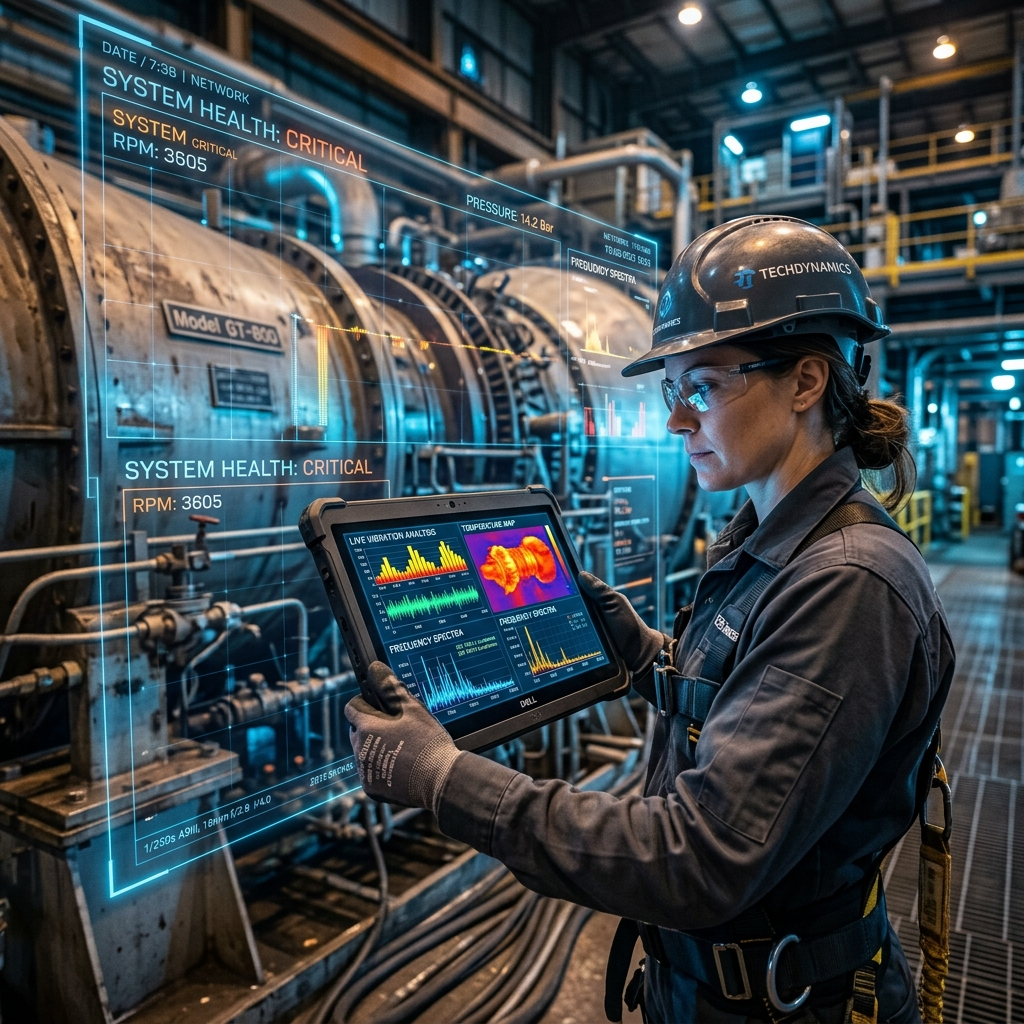
Rotating equipment and heavy machinery in industrial plants serve as the beating heart of production lines; their sudden failure can result in significant financial losses.
Traditional maintenance methods—based on fixed schedules or reactive measures taken only after a breakdown occurs—are no longer sufficient to meet the demands of modern industry.
Condition Monitoring is a modern, intelligent approach that continuously tracks the health of machinery.
By detecting early warning signs of failure, this technology prevents costly catastrophes and unplanned downtime.
In this article, we provide an in-depth examination of condition monitoring techniques, key parameters, and their role in sustaining industrial productivity.
Technical Description and Analysis
Condition monitoring is the process of measuring and evaluating specific physical parameters of machinery to determine its mechanical health during operation.
Vibration analysis is the most common and powerful tool among the techniques used for monitoring rotating equipment.
Every mechanical component possesses a unique vibration frequency; changes in this pattern indicate the presence of faults such as misalignment, imbalance, or bearing failure.
Infrared thermography is another technique that identifies electrical and mechanical issues by detecting abnormal “hot spots.”
Oil and lubricant analysis—which examines suspended metallic particles and changes in viscosity—provides vital information regarding the wear and tear of internal components in engines and gearboxes. Acoustic Emission testing detects high-frequency waves generated by microscopic cracks before they evolve into catastrophic failures.
Ultrasonic inspection is used to detect leaks in pressure vessels, examine valves, and identify partial discharge in high-voltage electrical equipment.
Motor Current Analysis monitors the health status of electric motors without requiring direct physical access to the motors themselves.
This data is collected in real-time via smart sensors installed on the equipment and transmitted to a control room for analysis.
With the advent of the Industrial Internet of Things (IIoT), condition monitoring systems have evolved from offline, periodic inspections to online, cloud-based monitoring.
Artificial intelligence and machine learning algorithms play a key role in processing the massive streams of data transmitted by these sensors.
These intelligent systems are capable of timely detection of complex failure patterns that might otherwise remain hidden from human experts.
Predictive maintenance is the ultimate outcome and primary objective of effectively implementing condition monitoring in industrial settings.
In this approach, components are repaired or replaced precisely when they actually require it—neither too early nor too late.
Costs associated with spare parts are significantly reduced, as functional components—which might otherwise have been discarded based on a calendar-based replacement schedule—are preserved.
Extending the service life of industrial equipment is another direct benefit of operating under optimal conditions, free from hidden mechanical stresses. Safety levels for operators and workshop personnel are significantly enhanced by eliminating the risks of explosions, sudden shaft failures, or the ejection of components.
Reducing unplanned downtime contributes substantially to increasing the Overall Equipment Effectiveness (OEE).
Documenting the health history of equipment assists engineers in selecting higher-quality brands and models for future procurement.
Clarifying the actual condition of machinery makes the budgeting process for the maintenance department more precise and justifiable.
In the oil, gas, petrochemical, and power generation industries, condition monitoring is a strategic necessity due to the high sensitivity of the equipment.
The use of portable tools by technical inspectors serves as an effective complement to fixed, online monitoring systems in lower-risk areas of the facility.
Periodic calibration of sensors and measuring instruments ensures the long-term accuracy of condition monitoring results.
Conducting Root Cause Analysis (RCA) following system alerts helps refine design and operational processes.
Continuous training for production line personnel and maintenance teams—enabling them to accurately interpret vibration and thermal charts—is an undeniable necessity.
Machinery operating at peak mechanical efficiency—achieved through condition monitoring—consumes less energy, thereby lowering operational costs.
Adherence to international ISO standards regarding vibration analysis enhances the credibility of the facility’s technical reports.
Condition-based monitoring safeguards production continuity and ensures the organization remains competitive in global markets. Conclusion
Industrial equipment condition monitoring is more than just a simple troubleshooting tool; it serves as the backbone of modern industrial maintenance strategies.
By integrating advanced sensor technologies, the Internet of Things (IoT), and artificial intelligence, these systems pave the way for a future free from unplanned downtime.
A smart investment in condition monitoring is the key to ensuring longevity, reducing costs, and achieving maximum productivity in leading industrial facilities.