
Modern industrial automation is no longer limited to controlling the sequence of operations, but has become a complex cyber-physical system that incorporates data, communication, analytics, and intelligent decision-making. In this article, we examine industrial automation from the perspective of system architecture, international standards, and implementation challenges.
Technical Definition of Industrial Automation
Industrial automation is a set of hardware, software, and communication protocols designed to provide closed-loop control of industrial processes with minimal human intervention. These systems typically include various levels of control from the Field Level to the Enterprise Level.
Layered Architecture of Industrial Automation
1. Field Level
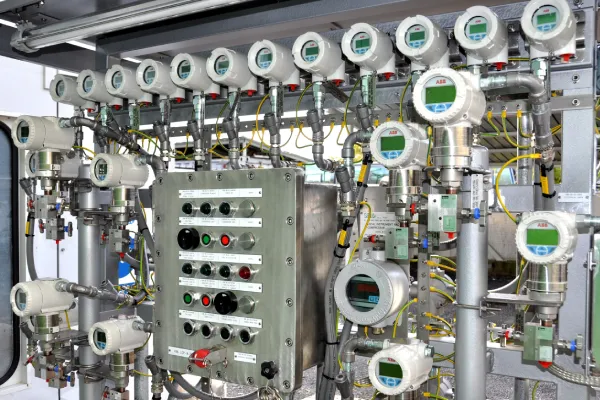
Includes sensors, transmitters, and actuators such as:
• Pressure Transmitter
• Flow Meter
• Control Valve
• VFD
These devices typically use 4–20mA, HART, or Modbus RTU signals.
2. Control Level
In this layer, PLC, PAC or DCS are used to implement control algorithms such as:
• PID Control
• Cascade Control
• Feedforward Control
3. Supervisory Level
SCADA and HMI systems are used for monitoring, alarming, data logging and operator control.
4. Enterprise Level
Connection with:
• MES
• ERP
• CMMS
For productivity analysis and management decision-making
Key standards in industrial automation
• IEC 61131-3 (PLC programming languages)
• IEC 62443 (Industrial cybersecurity)
• ISA-95 (IT and OT integration)
• OPC UA (Secure communication and data standards)
The role of industrial automation in predictive maintenance
By collecting process data and analyzing it, automation systems enable Condition Monitoring and Predictive Maintenance, which reduces unplanned downtime.
Implementation Challenges
• Legacy Systems Incompatibility
• Industrial Network Cybersecurity
• Skill Shortage
• High Initial Cost
Summary
Advanced industrial automation is the main pillar of data-driven and smart industries, and its proper implementation requires careful architectural design and compliance with international standards.