
Introduction
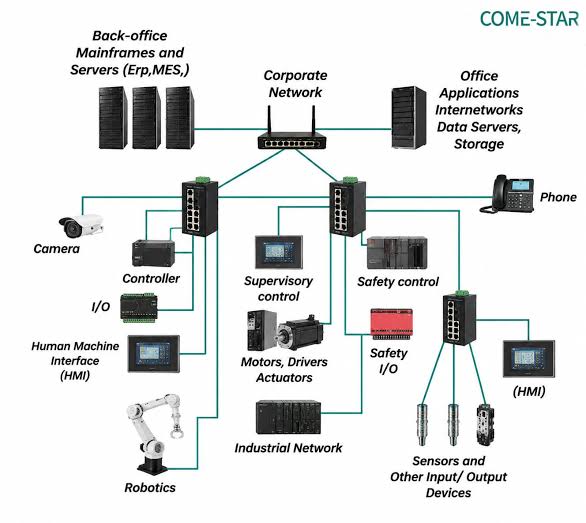
In a smart factory, various pieces of equipment must be able to exchange information with one another quickly and accurately. Controllers, sensors, drives, measuring instruments, and monitoring systems require reliable communication to coordinate their operations.
An industrial communication protocol is a set of rules that defines how data is transmitted, received, and interpreted between devices. Selecting the right protocol can enhance production line performance and prevent communication disruptions.
In industrial automation projects, names such as Modbus, Profibus, and Profinet are frequently encountered. Each of these technologies possesses distinct features, limitations, and applications; therefore, no single option can be considered the “best” choice for every project.
While a simple, cost-effective protocol may suffice for data transmission in some cases, projects involving a large number of devices—or those requiring high speed and real-time control—necessitate more advanced technologies.
In this article, we examine the differences between Modbus, Profibus, and Profinet, the criteria for selecting them, and key considerations for industrial network design, enabling more precise and well-founded decision-making in automation projects.
Details
An industrial communication protocol serves as a common language for industrial equipment. If two devices do not employ compatible communication methods, they may fail to exchange necessary information correctly—even if each device functions perfectly on its own.
Before selecting a protocol, it is essential to determine which equipment will be connected to the network. The specific types of PLCs, sensors, drives, distributed control systems (DCS), and monitoring equipment directly influence the choice of communication technology.
One critical criterion is data transmission speed. In applications where information must be transmitted within short time intervals, communication latency can affect control quality and machine performance.
The number of devices connected to the network is also significant. A network designed for a few small devices may encounter capacity limitations, latency, or management challenges if the number of nodes increases.
The Modbus protocol is a well-known and widely used method in industrial communications. Its simple structure, broad accessibility, and support across a wide range of equipment contribute to its popularity.
Modbus is utilized in various versions, such as Modbus RTU and Modbus TCP. The RTU version typically relies on serial communication, whereas Modbus TCP operates over an Ethernet network.
In Modbus RTU, communication is generally established via interfaces such as RS-485. This method is suitable for data transmission in many measurement and control applications, allowing multiple devices to be connected along a single communication path.
Modbus TCP leverages Ethernet infrastructure and the TCP/IP mechanism. This facilitates the connection of industrial equipment to Ethernet-based networks and various monitoring systems.
One of the advantages of Modbus is its ease of implementation and troubleshooting. However, on its own, the protocol does not provide the advanced scheduling and real-time control capabilities required for all industrial applications.
Profibus is a family of industrial communication protocols designed for data exchange between controllers and field devices. This technology is employed in numerous factory and process automation systems.
Profibus DP is primarily used for high-speed communication between a controller and distributed input/output (I/O) devices. In this structure, information from sensors and actuators can be exchanged systematically between the controller and field equipment.
Profibus PA is designed for process applications and facilitates communication with instrumentation used in process industries. The selection of this version should be based on environmental conditions, power supply requirements, and the safety specifications of the project.
A key feature of Profibus is the ability to integrate multiple devices within a defined communication architecture. However, proper topology design, adherence to cable length limitations, and the use of compatible equipment are essential for network stability.
Profinet is an industrial communication technology based on Ethernet, developed for communication between controllers, field devices, and automation systems. This technology leverages industrial Ethernet network infrastructure.
One of the capabilities of Profinet is its support for time-deterministic data exchange. This feature is highly beneficial in applications where precise coordination between devices is critical.
Profinet enables the detection and reporting of certain communication errors and device status information. This functionality assists maintenance teams in identifying and investigating network issues more rapidly.
The primary differences among these three technologies lie in their architecture and intended applications. Modbus generally serves as a simple and flexible option for data exchange; Profibus is utilized in fieldbus networks, while Profinet relies on industrial Ethernet-based communication.
Selecting the appropriate protocol requires determining the response time necessary for the project. In a tank monitoring system, data transmission at specific intervals may suffice; conversely, for high-speed machinery, precise timing is of greater importance.
The compatibility of existing equipment is another decisive factor. If a large portion of the factory equipment utilizes a specific protocol, opting for that same technology—or a compatible integration solution—can reduce development costs.
The network’s environmental conditions must also be assessed. Factors such as electromagnetic noise, temperature, humidity, vibration, and the distance between devices can affect communication quality, thereby influencing the selection of cables, connectors, and network hardware.
Furthermore, the security of industrial communications
This should not be overlooked. Implementing network segmentation, access control, restricting unnecessary communications, and monitoring traffic can reduce the likelihood of unauthorized access and system operational disruptions.
The total cost is not limited to the price of communication hardware alone. Expenses related to cabling, installation, programming, training, future expansion, and maintenance must also be factored into project calculations.
Before a full-scale network deployment, it is advisable to design a pilot or test setup. This phase allows for the evaluation of data exchange speeds, connection stability, equipment compatibility, and recovery procedures following a loss of connectivity.
Network documentation is a crucial part of the implementation process. Creating topology maps, device address lists, cable specifications, and configuration records facilitates easier troubleshooting and future system expansion.
Conclusion
Selecting the appropriate communication protocol is a critical decision when designing an industrial automation system. This choice influences data exchange speeds, network stability, scalability, and maintenance costs.
Due to its simplicity and widespread support, Modbus is a suitable option for many data exchange applications. Profibus is used in fieldbus networks for communicating with field devices, while Profinet is designed for industrial Ethernet-based architectures and more advanced communication requirements.
No single protocol is the best choice for every project. Factors such as the number of devices, response time, process type, existing infrastructure, environmental conditions, and future expansion needs must be considered during the decision-making process.
Network design must incorporate security assessments, thorough documentation, and practical testing. Selecting the right peripheral equipment and adhering to proper cabling standards are just as important as choosing the communication protocol itself. When designing a new industrial network or expanding an existing one, it is essential to conduct a technical assessment of equipment and process requirements prior to procurement and implementation. Such an approach can help prevent future corrective costs and unplanned downtime.