
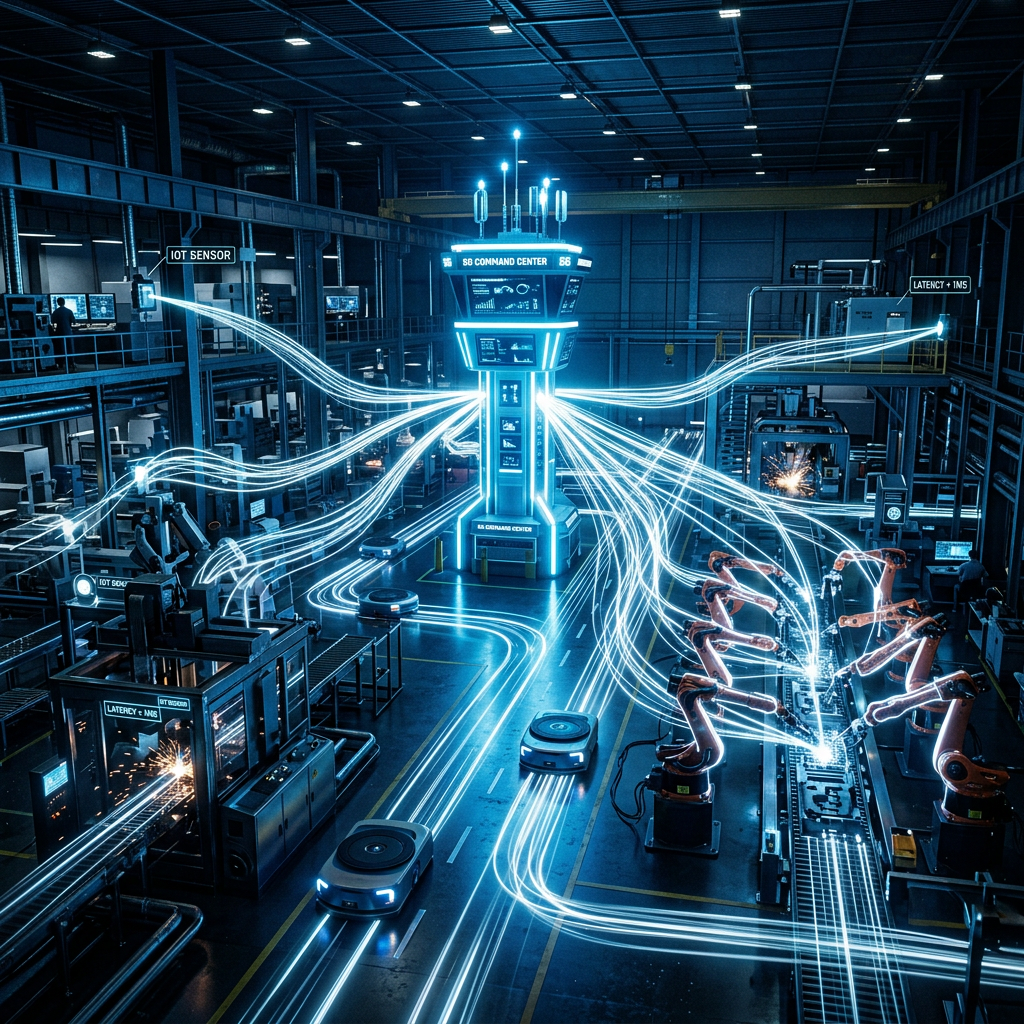
Industrial telemetry—or remote measurement—serves as the vital artery for monitoring and control within modern infrastructure, enabling engineers to oversee the status of critical equipment from kilometers away.
As industrial processes grow more complex and automation expands, the demand for faster, more reliable communication platforms with higher bandwidth has become increasingly acute.
Fifth-generation (5G) mobile communication networks act as a transformative catalyst, promising a fundamental shift in the architecture of industrial telemetry networks.
Previously, the high latency and instability inherent in older cellular networks forced industries to rely on costly wired infrastructure or limited, proprietary radio networks.
In this article, we provide an in-depth, technical examination of the role of 5G networks in the future of industrial telemetry, covering key technical parameters and operational applications.
Technical Analysis and Explanation
5G technology is not merely a simple speed upgrade over previous generations; rather, it represents a complete reimagining of how data is exchanged between machines, sensors, and central control systems.
A cornerstone of 5G that is revolutionizing industrial telemetry is Ultra-Reliable Low-Latency Communication (URLLC).
In traditional telemetry systems, network latency could sometimes reach hundreds of milliseconds—a delay that might be acceptable for monitoring basic parameters, but would be catastrophic for the real-time control of production lines. With 5G, data transmission latency in wireless networks can be reduced to less than one millisecond—effectively delivering performance on par with, or even superior to, traditional copper cabling.
This remarkable responsiveness enables the implementation of wireless closed-loop control systems, where telemetry data is instantly translated into control decisions.
Another key feature of 5G is Massive Machine-Type Communications (mMTC), which allows hundreds of thousands of sensors and actuators to connect to the network within a single square kilometer.
In a smart factory or an expansive oil field, this capability enables the simultaneous monitoring of individual valves, motors, and pipes without any degradation in signal quality.
In the past, high device density would lead to frequency saturation and the loss of telemetry data packets—a challenge that has been entirely resolved by 5G’s “network slicing” architecture.
Network slicing allows operators to reserve a dedicated, isolated portion of bandwidth—with specific quality parameters—exclusively for industrial telemetry.
This isolation ensures that critical telemetry traffic never interferes with general or administrative traffic, thereby maintaining both security and stability.
Furthermore, 5G’s Enhanced Mobile Broadband (eMBB) facilitates the transmission of massive volumes of multimedia data and high-quality video feeds from production lines. Instead of transmitting merely simple figures and numerical data, future telemetry systems will be capable of relaying live thermal and ultrasonic video feeds for precise analysis of equipment health.
The integration of 5G with edge computing technology fundamentally transforms the paradigm of telemetry data processing.
Rather than sending all raw data to a central cloud, the data is processed and analyzed at the network edge—in close proximity to the industrial equipment itself.
This hybrid approach drastically reduces network traffic load and brings the response time to anomalies down to a fraction of a second.
In the realm of predictive maintenance, 5G-enabled telemetry plays an indispensable role.
High-precision vibration, thermal, and acoustic sensors monitor the real-time status of rotating components and transmit data without interruption.
Artificial intelligence algorithms deployed at the network edge analyze this continuous stream of data, issuing alerts before catastrophic failures can occur.
In the oil, gas, and petrochemical industries—where facilities are often scattered across vast and difficult-to-access geographical areas—the cost of laying cables is prohibitively high.
Private 5G networks offer an exceptional solution for covering these expansive sites, eliminating the need for extensive physical infrastructure.
Resilience against harsh environmental conditions—such as dust, high temperatures, and electromagnetic interference—represents another key advantage of modern industrial wireless systems. In the realm of power distribution networks and smart grids, 5G-based real-time telemetry is critical for balancing network loads and detecting grid faults.
In the management of urban water and wastewater resources, 5G-enabled sensors allow for the optimal, real-time monitoring of reservoir levels and water quality.
In smart factories, autonomous industrial robots and Automated Guided Vehicles (AGVs) rely on real-time telemetry feedback for precise navigation.
Thanks to 5G’s ultra-low latency, these robots can operate in complex industrial environments in a coordinated manner, without the risk of collisions.
Cybersecurity in industrial telemetry has always been a primary concern for engineers and project managers.
Advanced encryption standards within 5G networks provide significantly greater security for data transmission—protecting against eavesdropping and cyberattacks—compared to Wi-Fi or legacy radio networks.
The use of industrial SIM cards (or eUICC) in telemetry equipment makes device authentication far more secure and enables centralized management.
The significant reduction in energy consumption by end-devices—achieved through 5G’s optimized protocols—extends the battery life of remote sensors to several years.
This feature serves as a vital advantage for Industrial Internet of Things (IIoT) projects where access to the main power grid is unavailable.
The flexibility and scalability of 5G infrastructure allow industries to…
New nodes can be added as production lines expand, without the need to redesign the network.
Long-term capital and operational expenditures (CAPEX and OPEX) are significantly reduced by eliminating the costs associated with cable maintenance and repair.
Industrial 5G standardization under 3GPP protocols ensures that equipment from various manufacturers can exchange data seamlessly.
Communication between SCADA systems and field equipment via 5G platforms offers greater stability and eliminates frequent connectivity interruptions.
Industrial Big Data analytics requires a continuous, uninterrupted flow of clean telemetry data—a requirement that 5G effectively fulfills.
Using 5G-enabled tablets and augmented reality (AR) headsets, on-site engineers can view real-time equipment telemetry data overlaid directly onto the physical environment.
The seamless integration of advanced technologies shifts industrial operations toward a model where human intervention in routine monitoring is minimized.
Conclusion
5G networks are more than just an advanced communication tool; they serve as a foundational infrastructure for digital transformation, enabling industries to enter the era of Industry 4.0.
The unique combination of ultra-low latency, massive bandwidth, and the capacity to connect hundreds of thousands of devices has transformed industrial telemetry from a simple monitoring tool into an intelligent control system.
By overcoming the traditional constraints of physical wiring and the instability of legacy networks, engineers and project managers can confidently pursue full-scale automation and the implementation of artificial intelligence. Investing in industrial 5G infrastructure will ensure higher productivity, a significant reduction in maintenance costs, and enhanced safety within the facilities of the future.
The outlook suggests that organizations that adopt this technology early will emerge as market leaders and models of efficiency in the modern industry of tomorrow.